
Photography · Aneta Ciepielowska - Netafoto · 2026 · 3 months
Netafoto - a photographer's site without a CMS, on three files
The whole site is three files and 44 lines of JavaScript: no framework, no build step, and no panel that nobody logs into.
- HTML
- CSS
- JavaScript
- WebP
- sharp
- GitHub Actions
The challenge
The previous version of the site had an admin panel, a blog, and a database, and Aneta never used any of them. She uploaded session photos where she always had, and the site just stood there. On top of that, the photos are the heaviest part of such a site: a dozen or so full-size shots per subpage, which a phone with a weak signal can wait for indefinitely.
Our solution
We threw out everything she didn't use. What remained is a plain static site with no framework and no build step: the homepage, About, the full price list, and six session subpages. Photos go through sharp to WebP, and deployment goes out by FTP from GitHub Actions. Contact is phone, email, and Facebook, with no form that nobody would handle.
3
Files for the whole site
44
Lines of JavaScript
0.27 s
First contentful paint
What we built
- 01 Nine subpages: home, About, the offer, and six kinds of session
- 02 Sessions: newborn, children, women's, wedding, maternity, first communion, 14-21 shots each
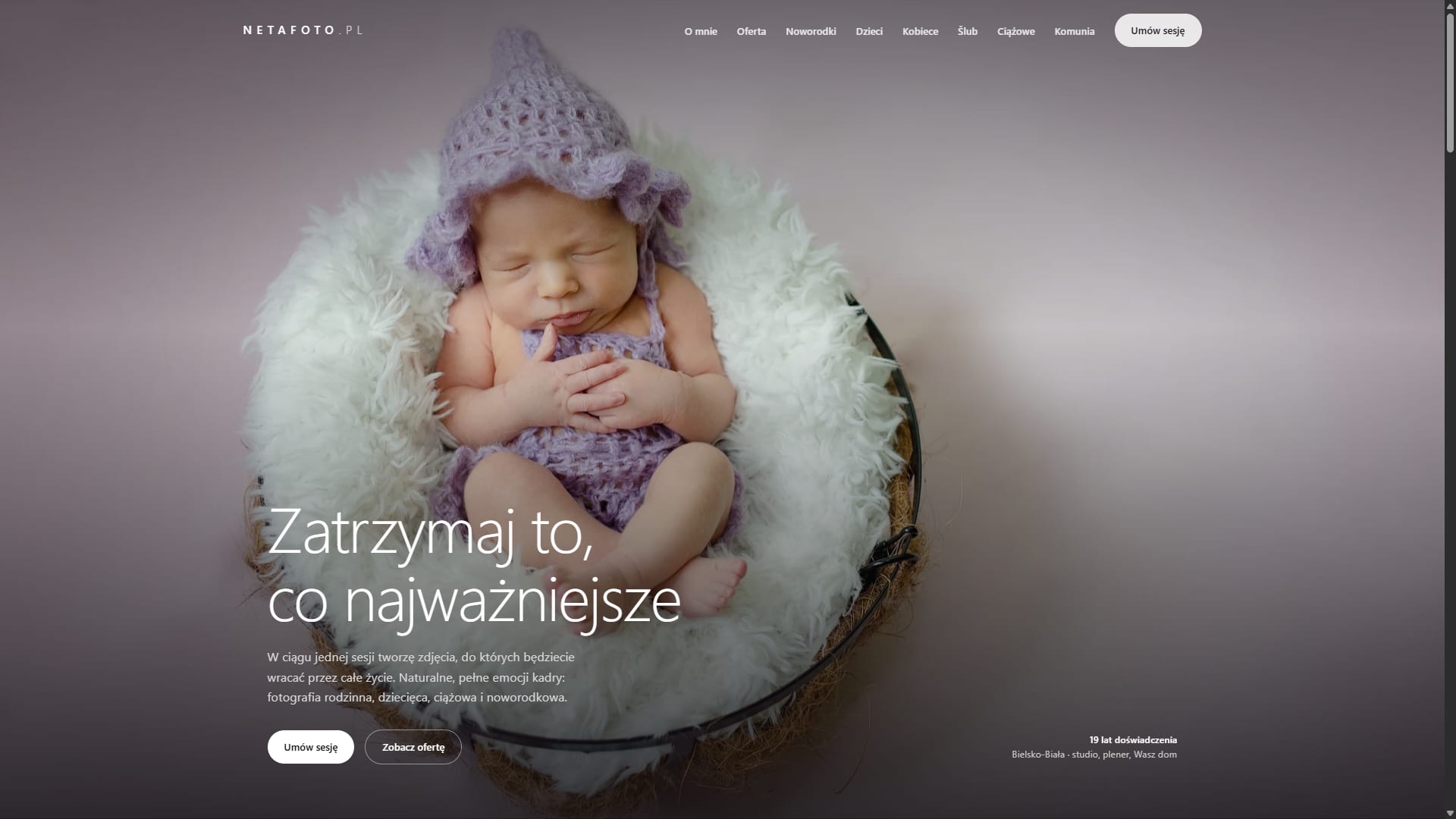
- 03 A full-width first screen with a portfolio photo
- 04 A "How it works" path: booking, session, receiving the photos
- 05 A price list with concrete amounts instead of an "individual quote"
- 06 Lightbox, navigation, and reveal in 44 lines of JavaScript
- 07 WebP photos processed by a sharp script
- 08 Redirects from the old subpage and blog addresses
- 09 A mobile menu with aria-expanded
- 10 Deployment by FTP from GitHub Actions
Contents +
Starting point
Aneta has been taking photographs for nineteen years: newborns, children, women’s sessions, maternity, first communions, and weddings. Clients come to her by recommendation and from Facebook, so the site doesn’t have to sell from scratch. It has to answer three questions: do I like these photos, how much does it cost, and how do I book.
The previous version answered the first and hid the other two. It is a problem we lay out more broadly in the piece on a photographer’s site: portfolio and client gallery (in Polish).
What is on the site
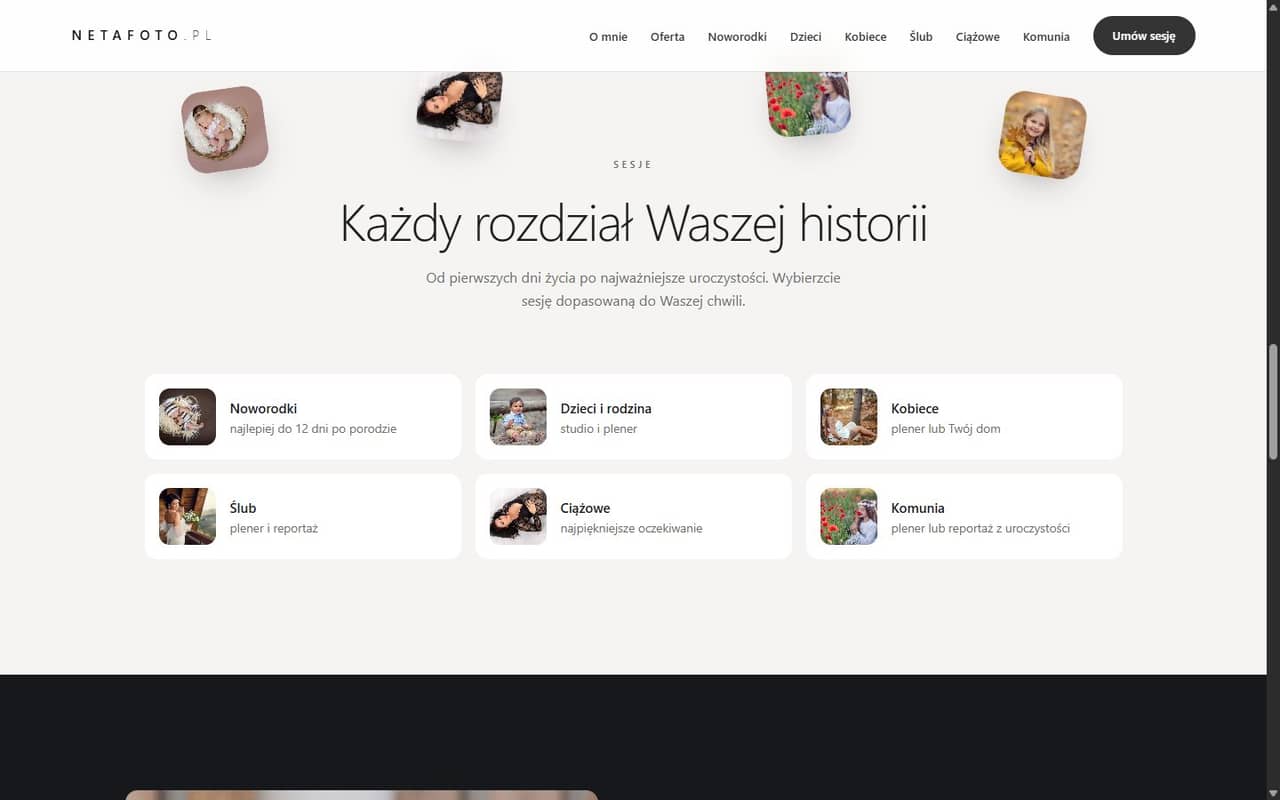
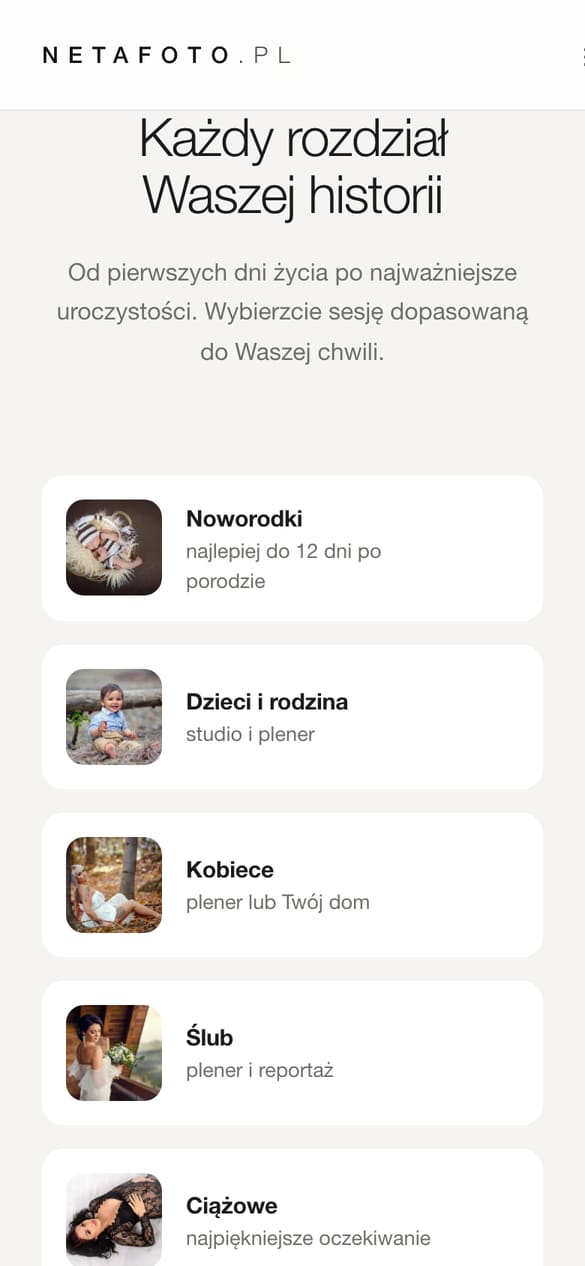
An ordinary business site, not a portfolio gallery. The homepage leads through what a client wants to know: the first screen, three steps from booking to receiving the photos, a short “about me”, six kinds of session, a short price list, and contact. There is a separate About page and a separate full offer.
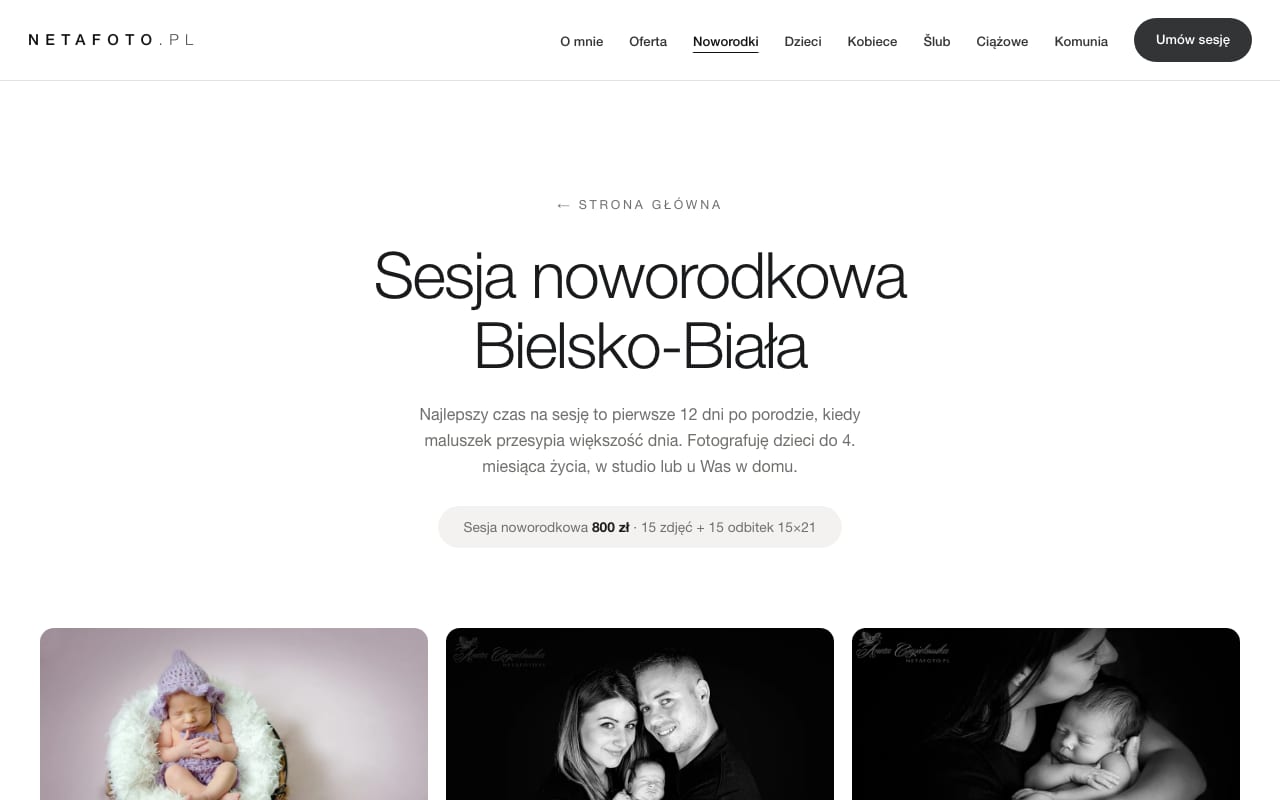
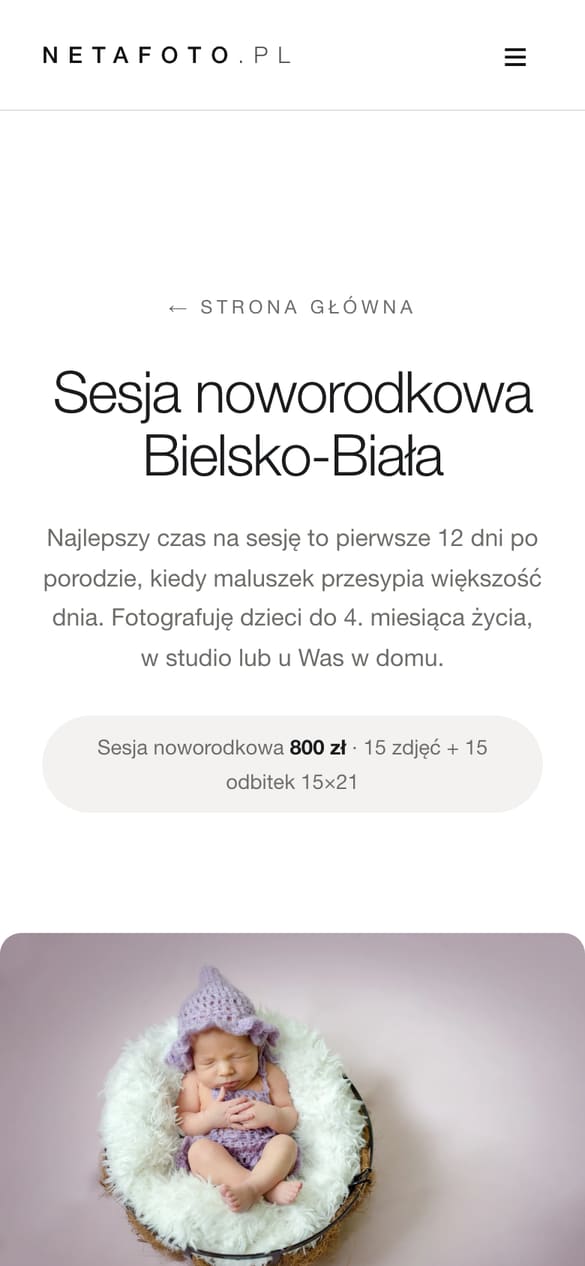
The six session subpages are offer pages, not galleries in themselves: a heading with a description of when that kind of session makes sense, the price right below it, and only then the photos, from 14 to 21 shots, over a hundred in all.
Decisions that shaped the project
No framework and no build step
The site changes a few times a year: a new session for the gallery, a price correction. A build step at that frequency is a cost with no return: you have to remember the command, maintain the dependencies, and fix the build when something drifts after half a year. Static HTML with one stylesheet and one JS file is uploaded by FTP and will work in five years without being touched.
It isn’t a rule we apply everywhere. It is a conclusion from this specific case: one person, rare changes, no dynamic content.
Removing the CMS panel
The hardest decision in this project was to remove working code. The panel, the blog, the login, and the database integration stayed in the repository as files of the previous version, but disappeared from the site. Maintaining a panel that nobody logs into is a security and update cost paid for a feature with zero use.
The blog stayed where Aneta actually writes: on Blogspot. The old blog address and the old subpage addresses redirect to the new places, so links from Facebook and Google don’t land in a void.
Photos reduced by script, not by eye
Photos from a session are heavy by definition. They go through sharp: resizing and compression at quality 82, and they sit on the site as WebP. At that quality the difference isn’t visible even on a good screen, and the file is several times smaller. The script is in the repo (npm run optimize-gallery), so the next batch of photos gets the same treatment, instead of depending on someone remembering to export from Lightroom with the right settings.
The photo on the first screen is excluded from optimisation. It is the one frame where full quality makes sense, because it fills the whole screen. Every shot below the first screen has loading="lazy".
The price list up front
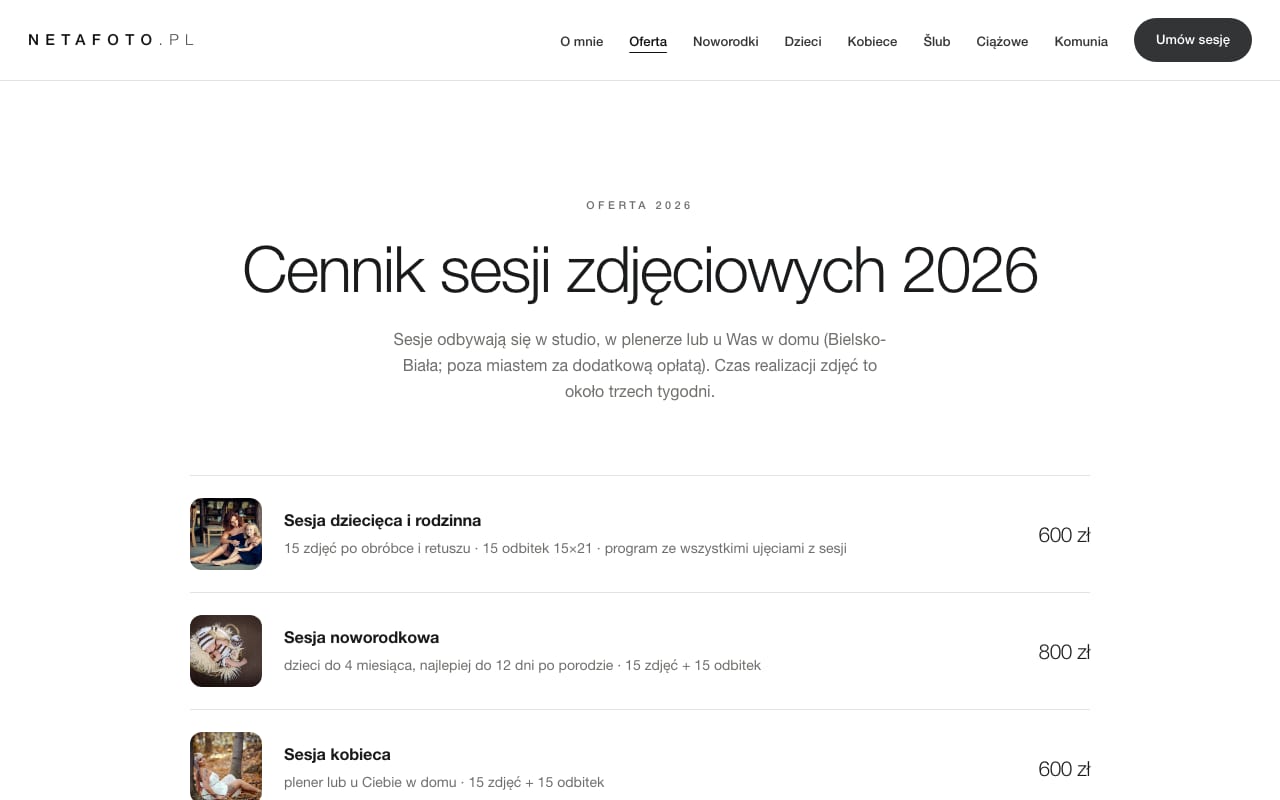
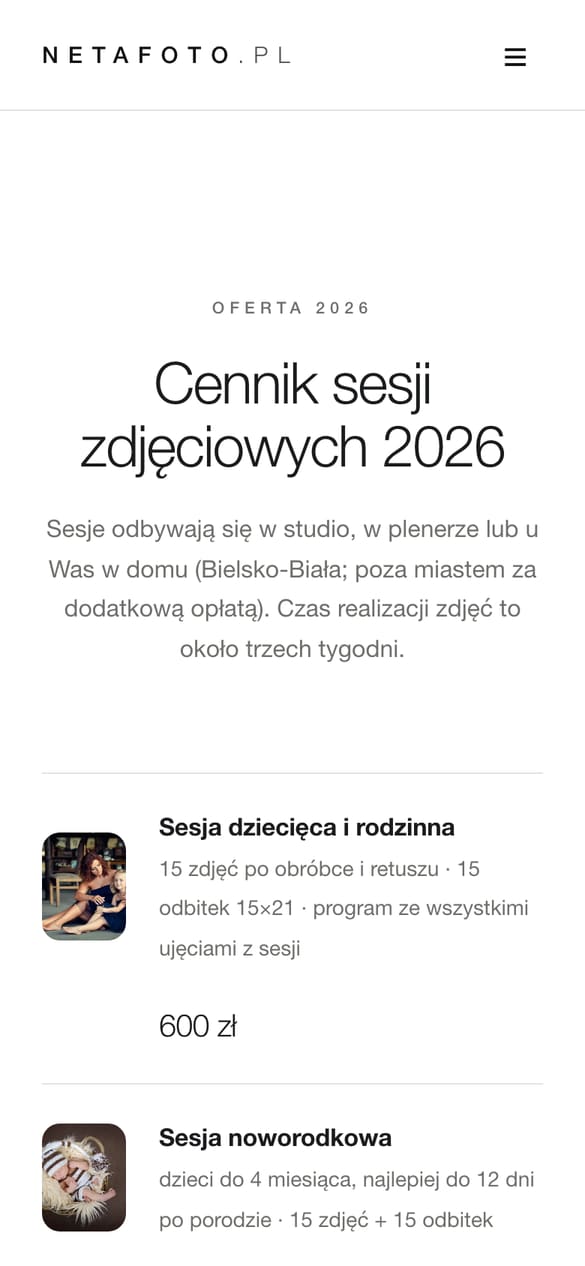
A newborn session is PLN 800, women’s, maternity, children’s, and family sessions PLN 600 each, a communion PLN 600 outdoors or PLN 1,000 with a reportage, an engagement shoot and a civil wedding PLN 1,200 each, with a deposit of PLN 200. Concrete amounts instead of an “individual quote” filter out enquiries that would get no answer anyway, and shorten the conversation with those that stay.
Under the price list are eight cards with conditions that previously had to be pulled out in conversation: a turnaround of about three weeks, PLN 30 for an extra shot, two free shots for returning clients, session accessories included, and gift sessions.
Contact without a form
A phone number, an email, and Facebook, repeated in the footer of every subpage. Aneta books sessions by phone and Messenger anyway, so a form would be a fourth inbox to check, and the first one that would be forgotten. It is the reverse of what we describe for the contact form that generates leads (in Polish): there a form makes sense because someone actually handles it, and here it doesn’t, because nobody would.
A lightbox without a library
Clicking a shot opens it full screen, and Escape closes it. Together with the navigation and the sections appearing, it fits in 44 lines of script.js, working on a few CSS classes. A lightbox library alone weighs more than this whole file and adds a dependency to keep updated. The sum is similar to the one in the piece on microinteractions and conversion (in Polish): an effect has to pay off, not just look good.
What came out of it
Homepage measurement from 13 September 2026, headless Chrome 1366×900, no cache: 44 ms to first byte, 0.27 s to first contentful paint, 0.51 s to the load event. Fourteen requests: the document, one stylesheet, one JavaScript file, and eleven images, 673 kB of transfer.
This is a measurement of the homepage, not of the six session subpages, where over a hundred shots sit. We didn’t check those pages in this measurement, so we don’t know how they behave on a slower connection. That is exactly the place where it is worth reaching for the Core Web Vitals checklist (in Polish) for the next batch of photos. We also have no result from the previous version with the CMS to compare, because nobody measured it that way, so we aren’t writing about an improvement, only about the state as it is now.
Technically
Static HTML, one styles.css, one script.js (navigation that changes over the hero, a mobile menu with aria-expanded, a reveal on IntersectionObserver with a 70 ms stagger, a lightbox). Photos in WebP next to the source files. Deployment: a push to main starts GitHub Actions, which sends the files by FTP to the hosting.
Screenshots


The first screen: a portfolio photo as the background, with the text and a button on top.
A similar problem to solve?
Tell us briefly what it is about. We will send a quote within 24 hours.
Ask for a quote →