
AI automation
AI automation for business
Whatever someone on your team clicks through every Monday can run on its own. Scripts that rewrite data, write content, or answer customers, with a clear token bill and no markup from us.
When it makes sense
- 01 Someone on your team retypes the same data between a store, a warehouse, and a spreadsheet.
- 02 Your blog has sat empty for a year because nobody has time to write, and a copywriting agency costs several thousand a month.
- 03 Customers ask the same questions every day, and the answers live in your head or in your inbox.
- 04 You have a catalogue of thousands of products with no descriptions or meta tags.
What you get
- /01
A blog that improves itself
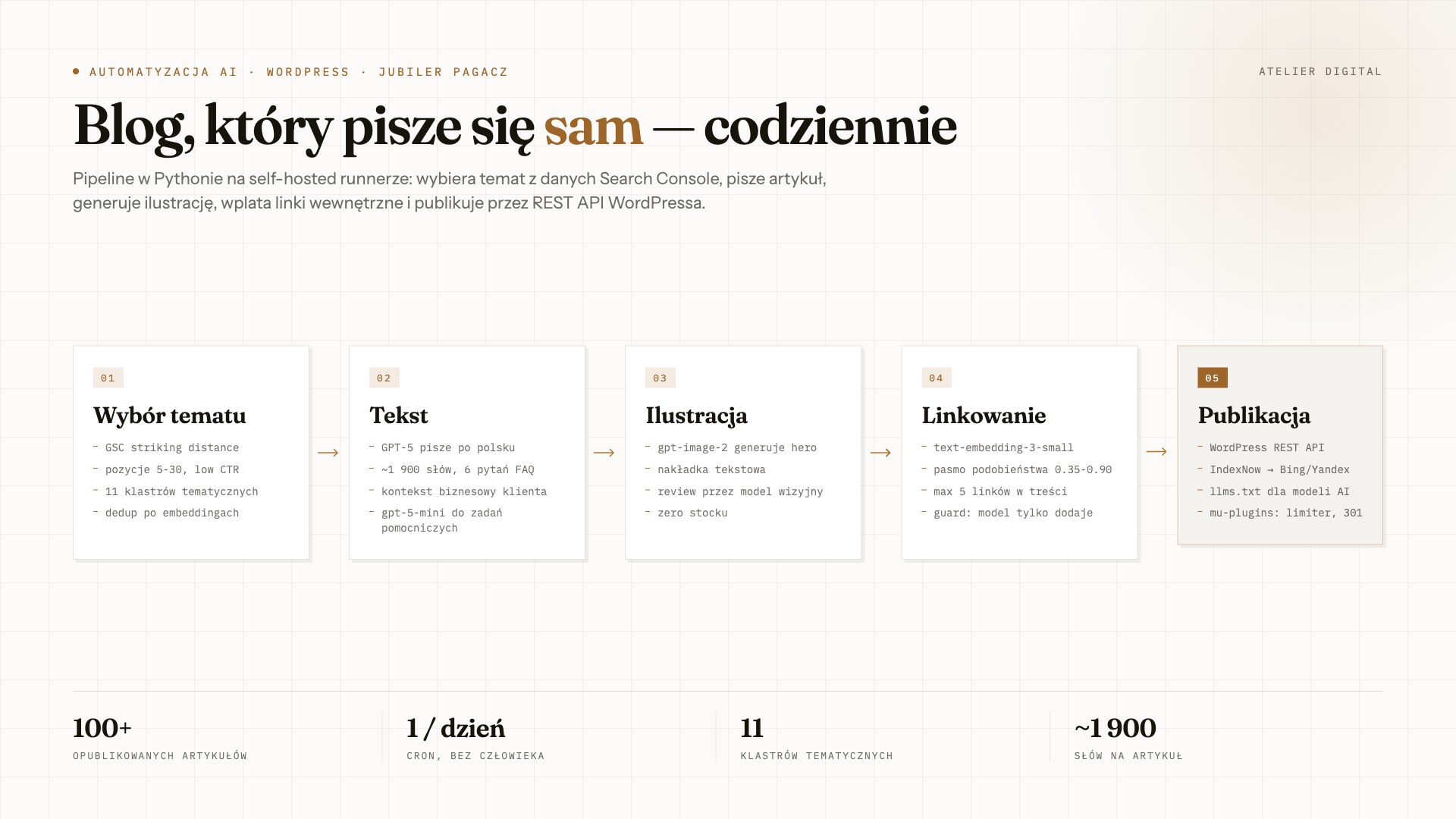
Every week the pipeline checks Search Console for posts Google already shows but people don't click. It rewrites their title, description, and weakest sections. New topics come from queries where you rank 5–30, because a small piece of content gives a real jump there. Every post waits as a draft for your approval.
- Search Console
- Refreshing low-CTR posts
- Topics from positions 5–30
- Draft for approval
- Internal linking
- Monthly report
- /02
Chatbot and customer support
A bot built on your own knowledge base (pricing, terms, FAQ, documentation), not on whatever the model makes up. What it doesn't know, it doesn't guess: it hands the conversation to a person and leaves a transcript.
- Knowledge base
- Website widget
- Messenger
- Human handoff
- Transcripts
- /03
Processes and integrations
Two systems that refuse to talk to each other, and a person acting as the cable between them. We connect them with a webhook or a cron job: orders to invoicing, enquiries to CRM, emails sorted and paired with a draft reply.
- Webhooks
- Cron / GitHub Actions
- REST API
- Baselinker
- Spreadsheets & CRM
- Email classification
- /04
E-commerce with AI
A catalogue nobody will describe by hand. We generate descriptions, meta tags, and categories from your product data, translate the catalogue into another language, and make sure you don't end up with three versions of the same text.
- Product descriptions
- Meta title / description
- Catalogue translation
- Categorisation
- Feeds
- /05
Launch and upkeep
The scripts run on your own account and your own API keys. You get the repository, logs from every run, and an alert when something breaks, so a quiet blog doesn't stay quiet for three weeks.
- Your own API keys
- Repository
- Run logs
- Failure alerts
Full price ranges and the list of add-ons: pricing.
Process
Four steps, no surprises halfway
- 01
Call
You tell us what the site is for and who it's for. We put the scope in writing, so nobody adds "just one more section" halfway through. You pay in three instalments: 30% at the start, 40% after design sign-off, 30% after delivery.
- 02
Mockup
You get a design in Figma with the layout, states, and small interactions. We revise it until it stops feeling "almost, but not quite".
- 03
Code
Astro, React, or WordPress, depending on the project. Every week we show what's new, so you see progress as it happens. We tune speed, SEO, and animations along the way, not "at the end, if there's time".
- 04
Launch
Testing, sign-off, deployment. The domain and code stay in your account. After sign-off you get three cosmetic revisions in the price, CMS training, and support after launch.
Work in this category
-
01 / AI AUTOMATION 2026 · 10 months (ongoing)
A jeweller's auto-blog
Over 120 articles without a single hour of copywriting. In 28 days (21 Oct – 17 Nov 2026) the blog brought 265 clicks from Google, 53% of Google clicks across the whole store. If a query already has a post in the results, a second one isn't written.
- Python
- GPT-5
- OpenAI Embeddings
- WordPress REST API
Read the full story →
-
02 / AI AUTOMATION 2026 · 8 months (ongoing)
Picvelo auto-blog
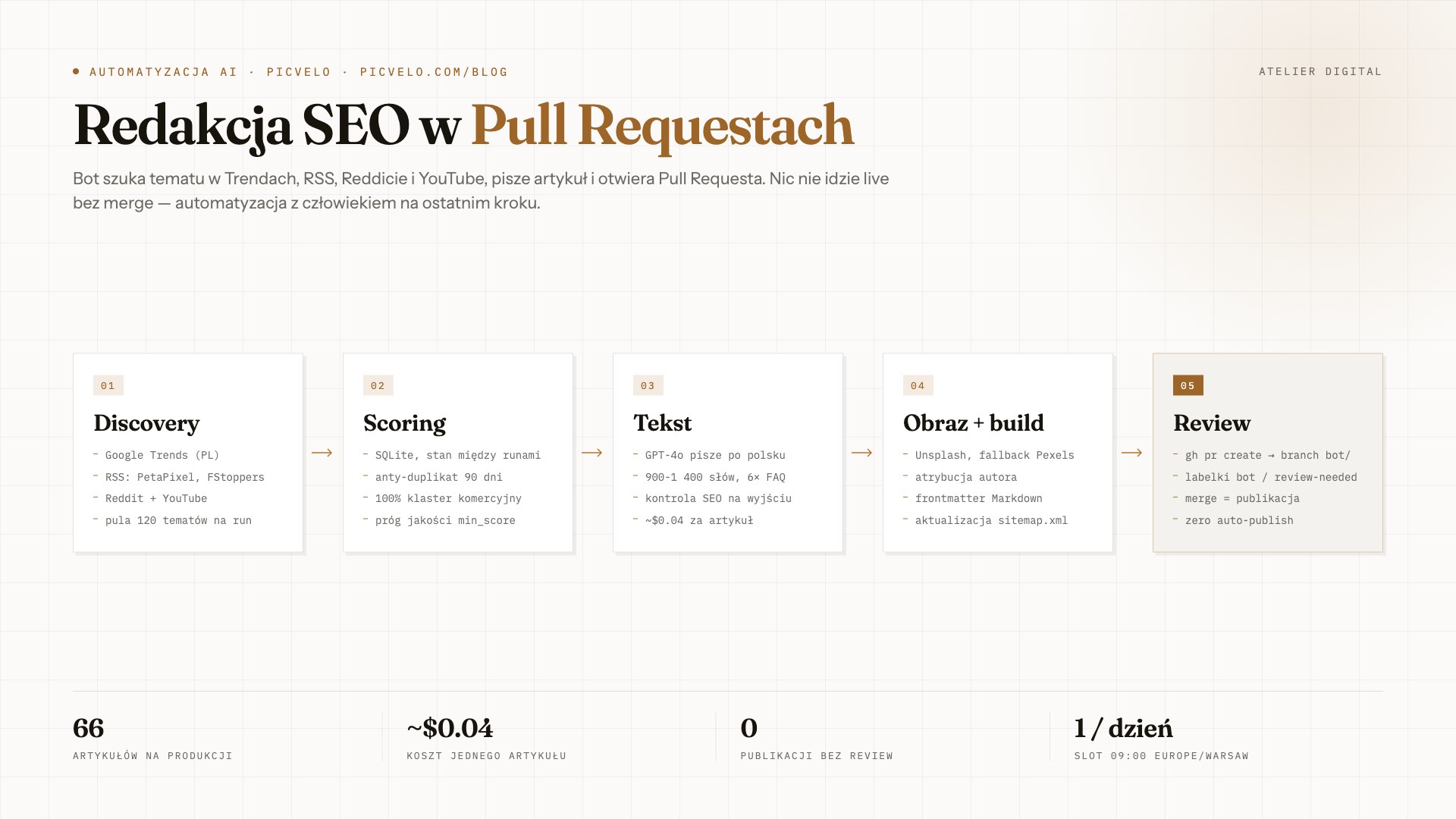
The whole blog has cost about $3 in tokens since June. The expensive part turned out to be something else: 74 posts written from the model's memory brought three clicks. The current version collects facts from the product database before it starts writing.
- Python
- OpenAI Responses API
- gpt-5.6
- SQLite
Read the full story →
-
03 / AI AUTOMATION 2026 · 3 months (ongoing)
Google Ads run with code
A campaign is built from a specification file and lands in the account paused, so no script can accidentally start spending money.
- Node.js
- Google Ads API
- Anthropic API
- SQLite
Read the full story →
Frequently asked questions
What does it cost every month, after launch? +
You pay for our work once. You pay for the tokens the script uses directly to the provider, with no markup from us. Rough order of magnitude from a live deployment: a blog article costs about $0.04, so one post a day comes to a few zloty a month. A chatbot depends on conversation volume. Before we write anything, you get an estimate of that cost.
Doesn't Google penalise AI-written content? +
Google penalises worthless content, whoever wrote it. That is why the pipeline doesn't write at random: it takes the topic from your Search Console data, grounds the text in your business context, and every post waits for your approval. The number of articles means nothing by itself; clicks do. So every month we show you clicks and impressions from Search Console, and we fix weak posts instead of adding more.
How does the blog subscription work? +
We do the setup once: connect Search Console, teach the pipeline your offer, and set up drafts for approval. After that you pay monthly for the running: new posts, fixes to the ones that get impressions but few clicks, and a Search Console report. First results show after 2–3 months, because Google needs time to re-evaluate changed pages. If clicks don't grow after three months, we say so plainly and suggest ending the engagement.
What if the bot tells a customer something wrong? +
That is why the bot answers from your own material, not from the model's general knowledge, and has a clear boundary: what isn't in the knowledge base, it doesn't guess. It hands the conversation to you instead. You keep the transcripts, so you can see what people are actually asking.
Who owns the scripts and the keys? +
You do. The code goes into your repository, the API keys sit on your account, the cron job runs on your infrastructure. If another team picks it up later, they have something to work with, and you can drop us without switching off the automation.
Where do we start? +
With one process, not ten. We pick the one eating the most hours, automate it end to end, and watch for a month to see what it really saves. Only then do we decide what is next.
Describe your project
We will come back with questions and a rough quote within 24 hours.
Contact
Ready to start your project?
Tell us what you want to build. We'll come back with questions and a rough quote within 24 hours.