Business website · Shellcrew Vault - own product · 2026 · a week, then developed during the test
Shellcrew Vault - a crypto service site that builds trust
The homepage is six of our own files and 68 kB, and the first content appears after 0.2 s, despite a 3D steel plate, headings revealed line by line, and an interactive wallet demo.
- Astro
- TypeScript
- GSAP
- FastAPI
- SQLite
- Cloudflare Turnstile
- Umami
- Caddy
- Docker
- GitHub Actions
The challenge
Shellcrew Vault helps people keep crypto on their own hardware and write down for their loved ones how to get to it. The keys stay with the client: the company holds nothing and has no access to the funds. The client is 35-60, not technical, and has a reason not to trust anyone who talks about crypto on the internet. The site had to sell a service that can't be shown in a photo to a person who suspects a scam by default.
Our solution
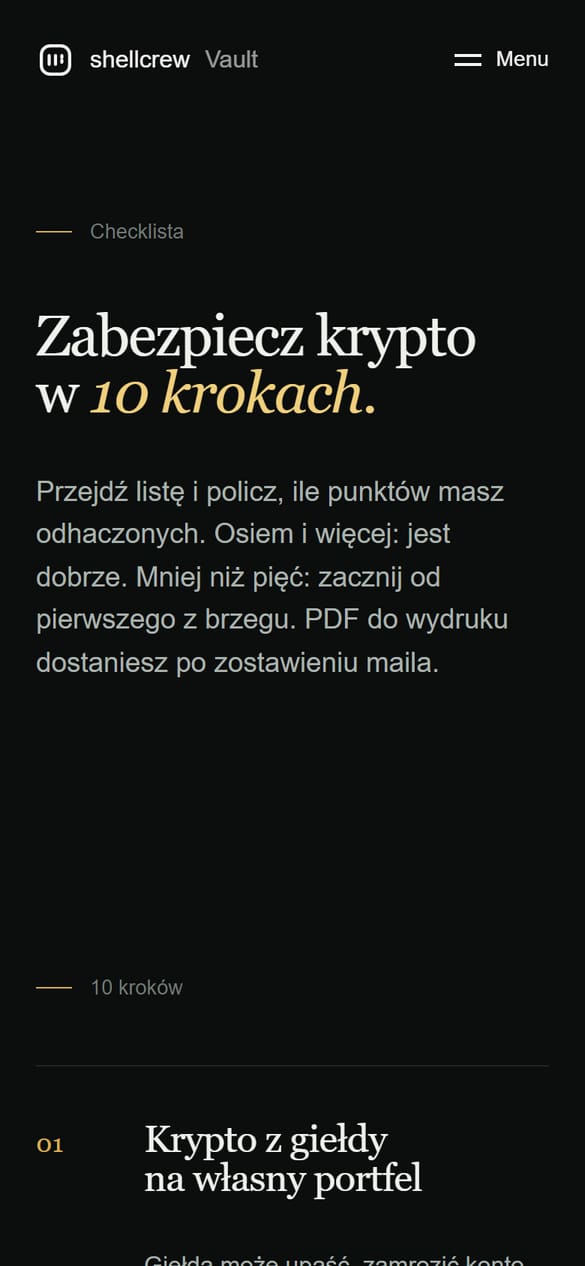
Instead of promising security, the site shows it. An interactive 2-of-3 wallet demo lets you lose a key and see that the funds are still safe. A big "0" says how many of the client's keys the company holds. Prices are on the page from day one. On top of that come two service subpages, a "Secure your crypto in 10 steps" checklist with a PDF in exchange for an email, and guides. Sign-ups go to our own API, which survived the change of product without a single fix.
6
Requests to our own files
68 kB
Weight of our own files
0.2 s
First contentful paint
8 weeks
Market test before the decision
What we built
- 01 A full-window-height first screen: a heading revealed line by line and a 3D steel seed plate that tilts after the cursor
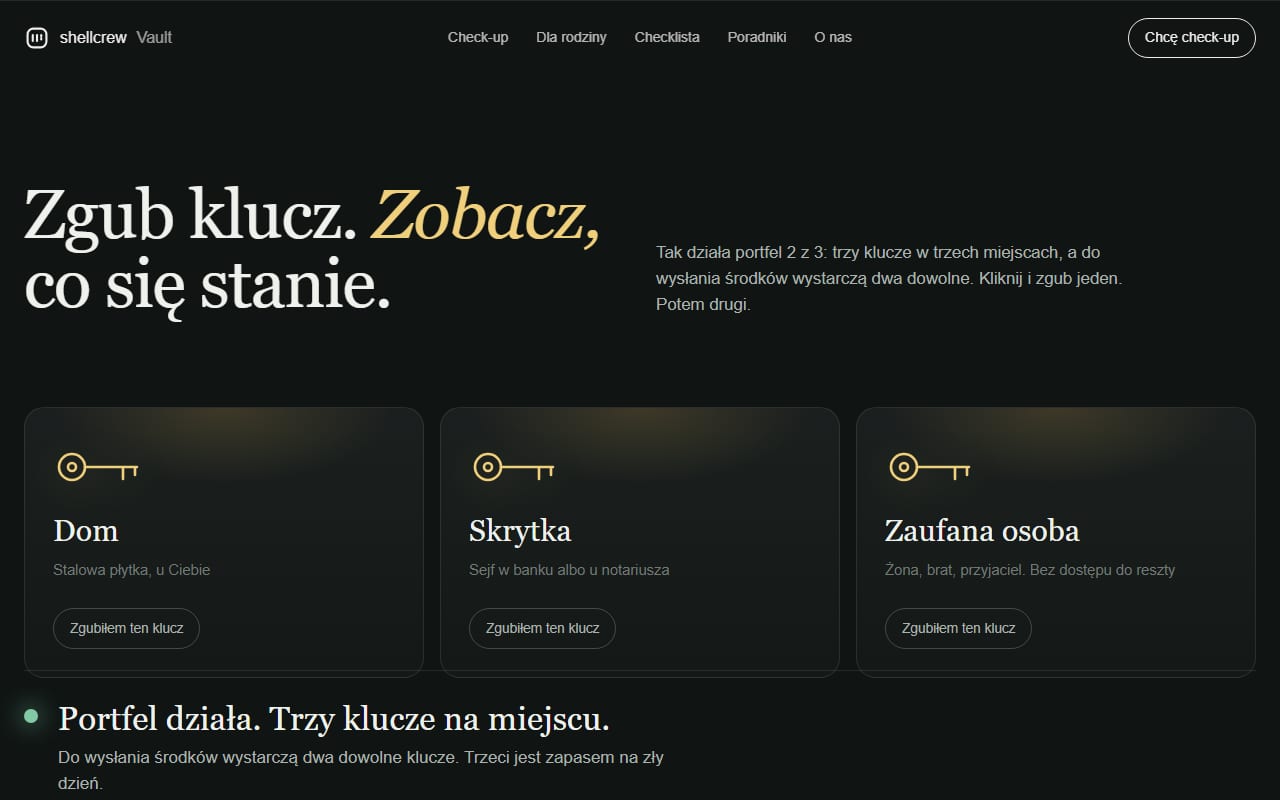
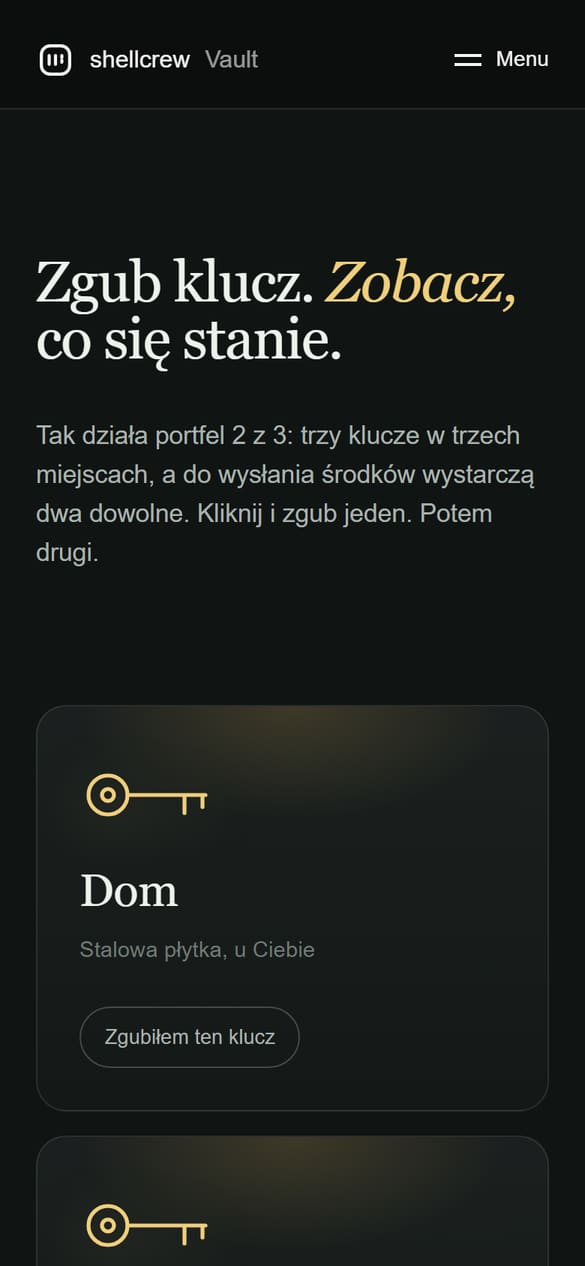
- 02 A 2-of-3 wallet demo: three keys in three places, with a "I lost this key" button on each
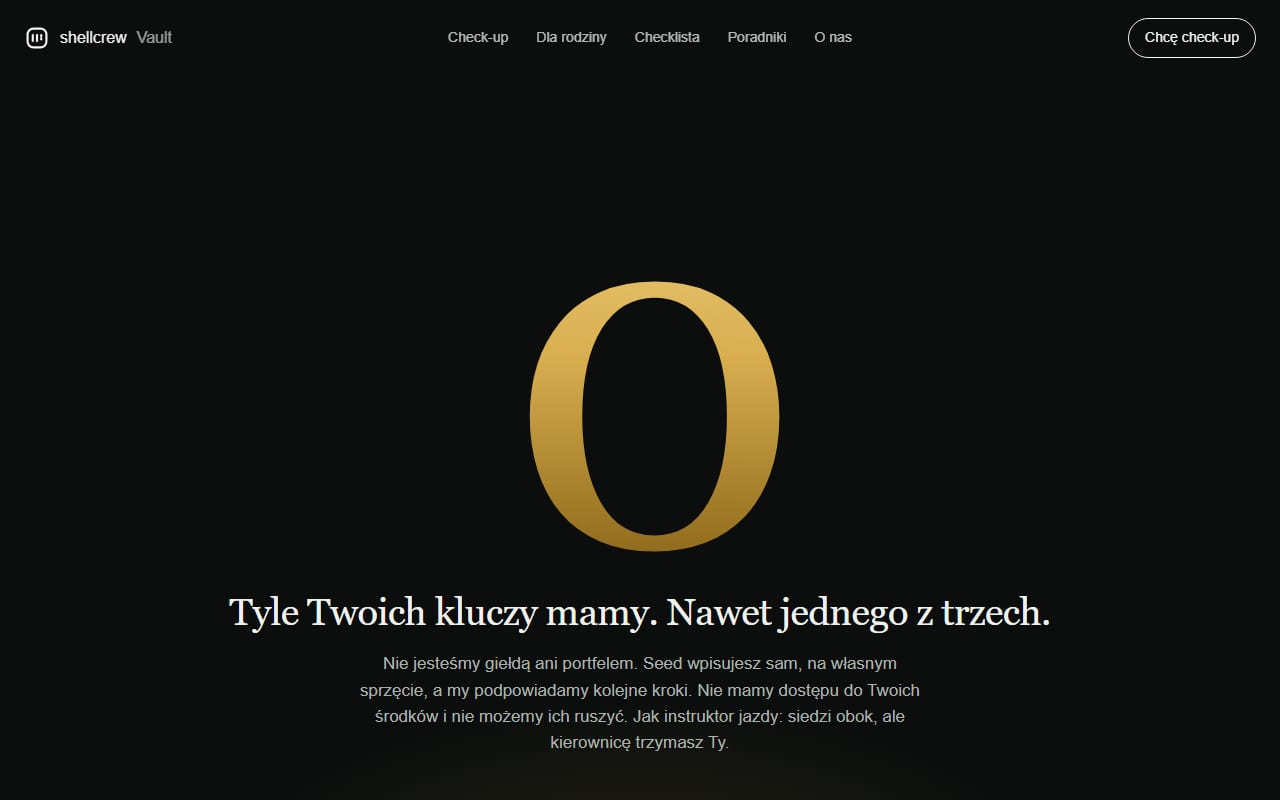
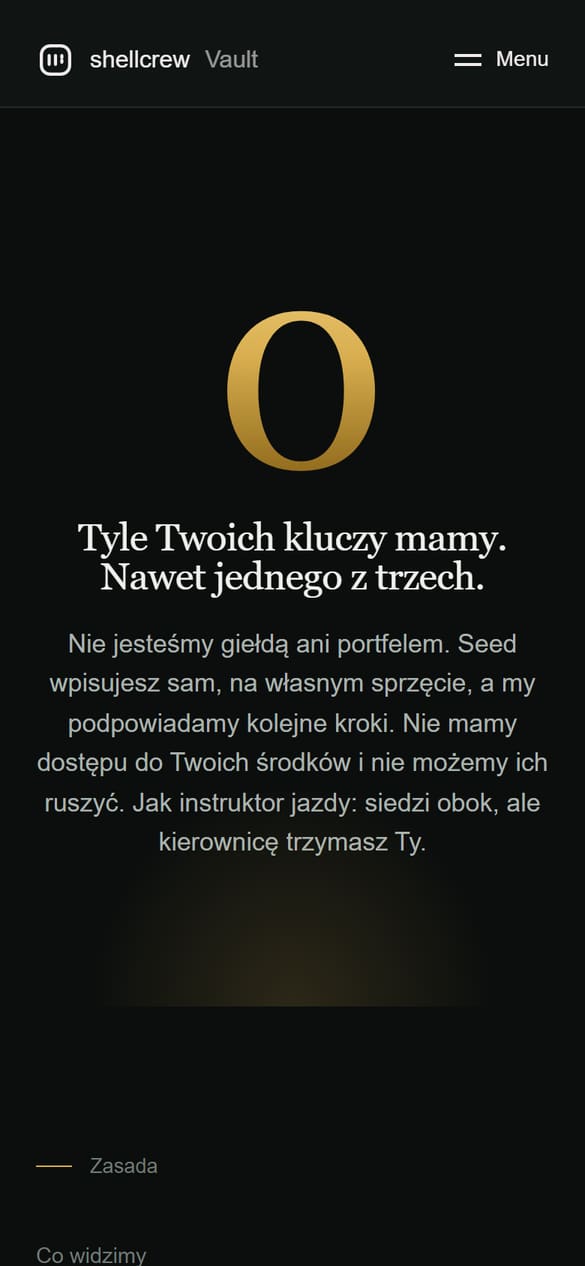
- 03 A section with a big "0": that is how many of the client's keys the company holds
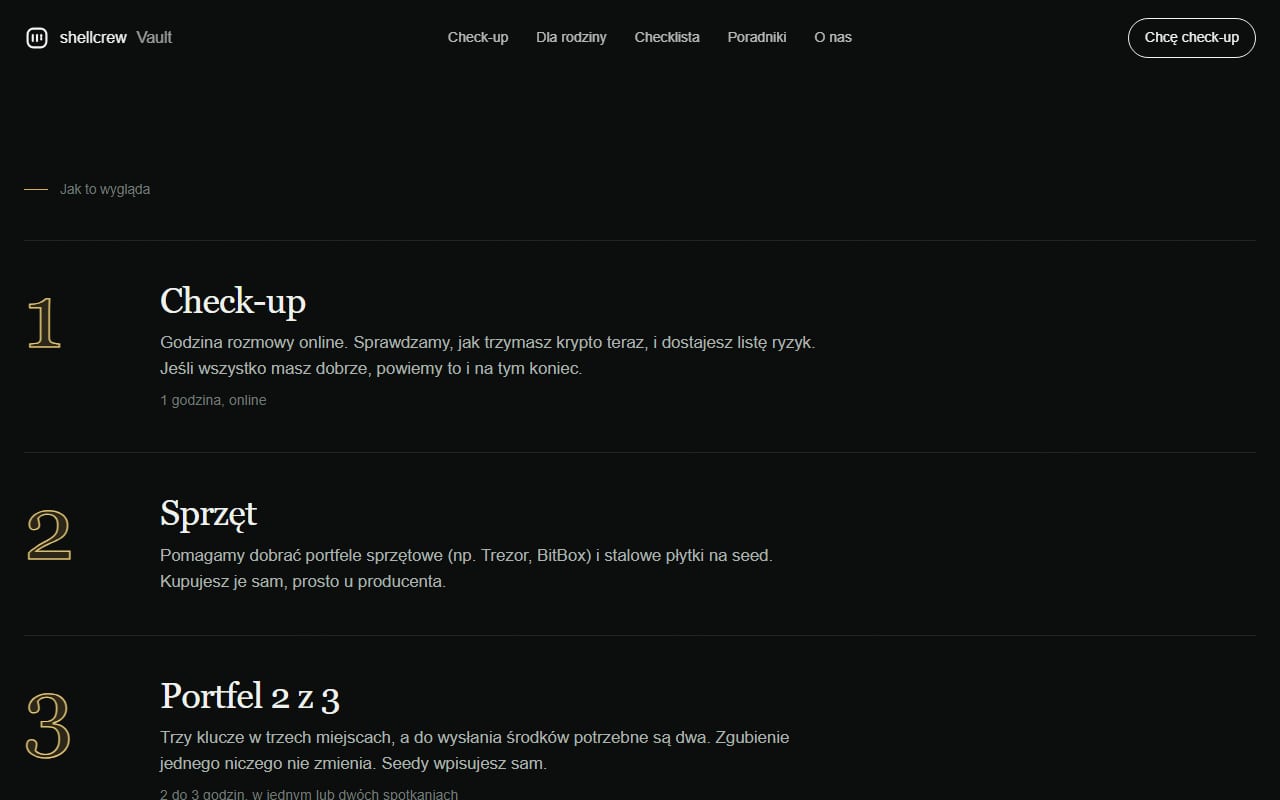
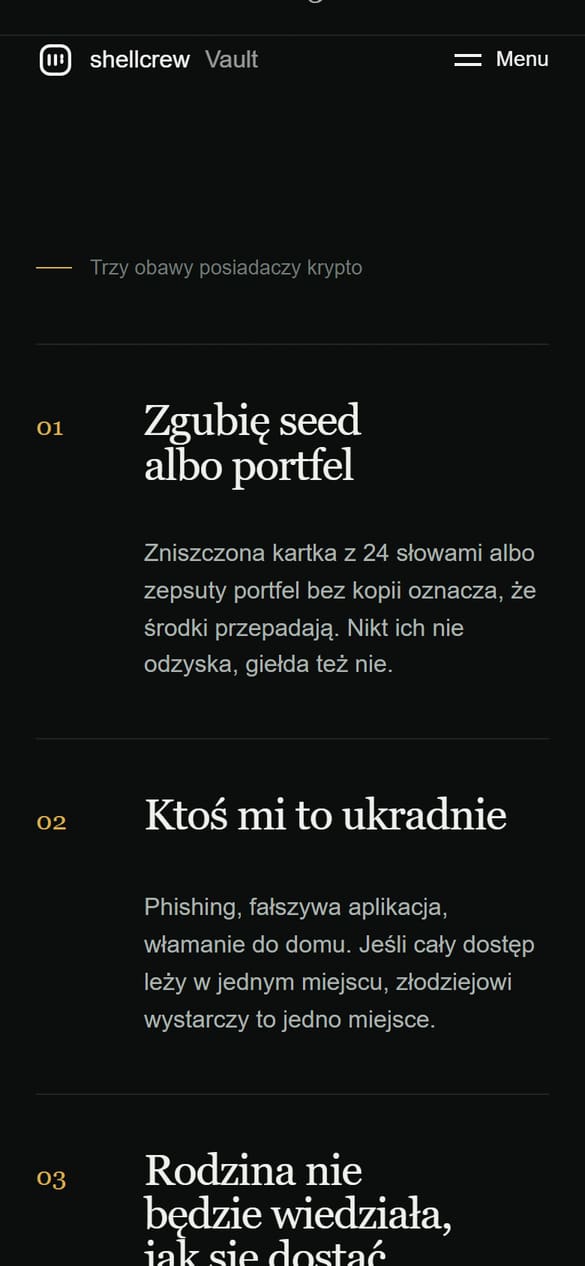
- 04 Three worries of crypto holders as three large rows, and the course of the work in numbered steps
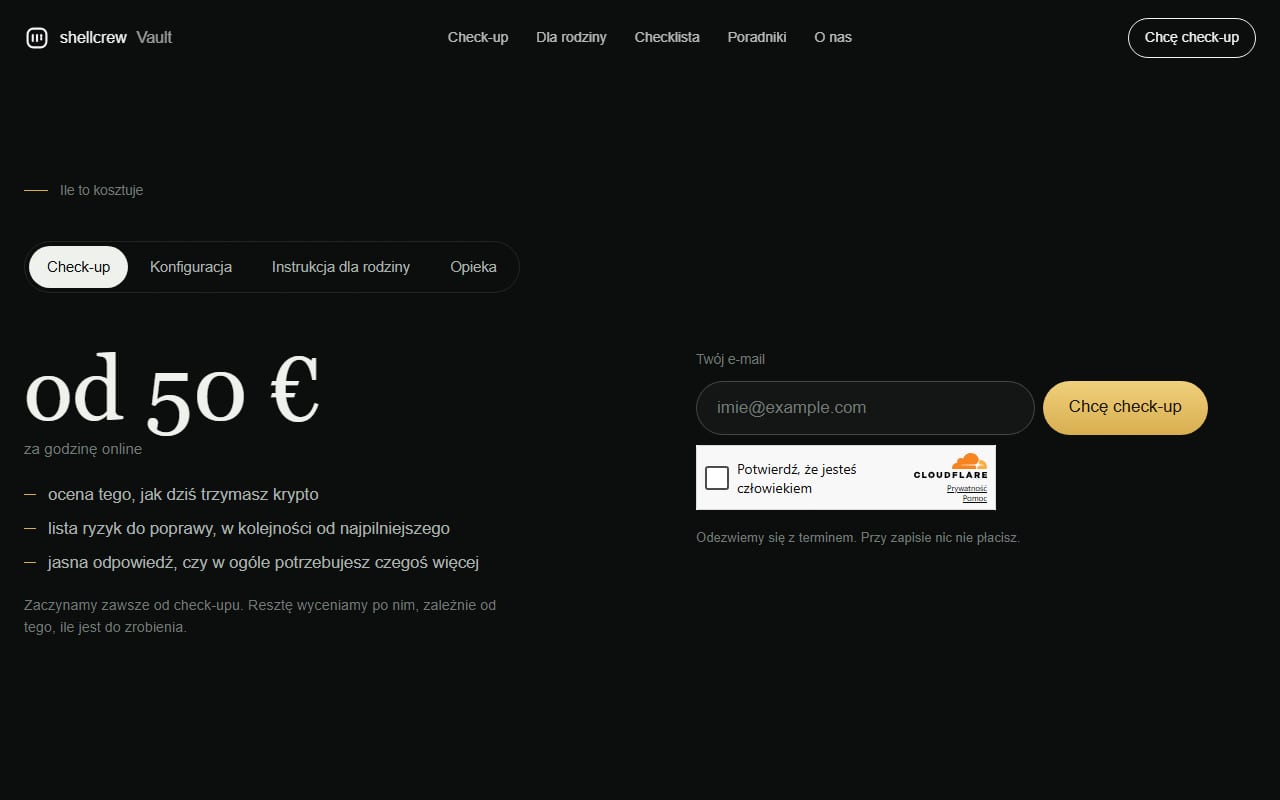
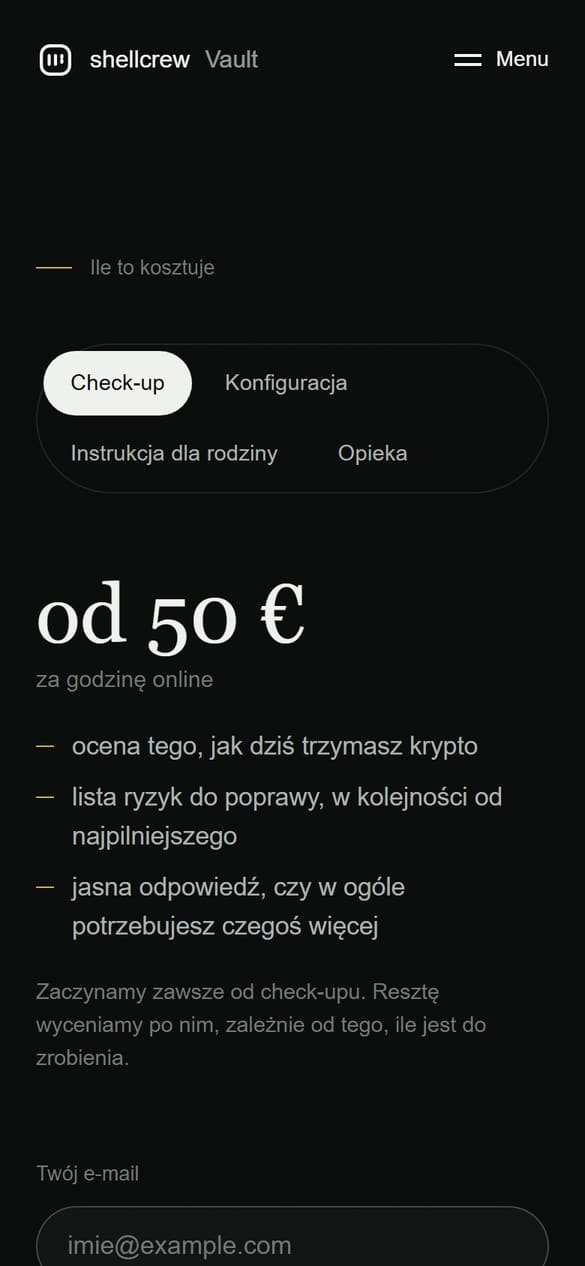
- 05 Pricing with a switch between four packages: check-up, setup, family instructions, care
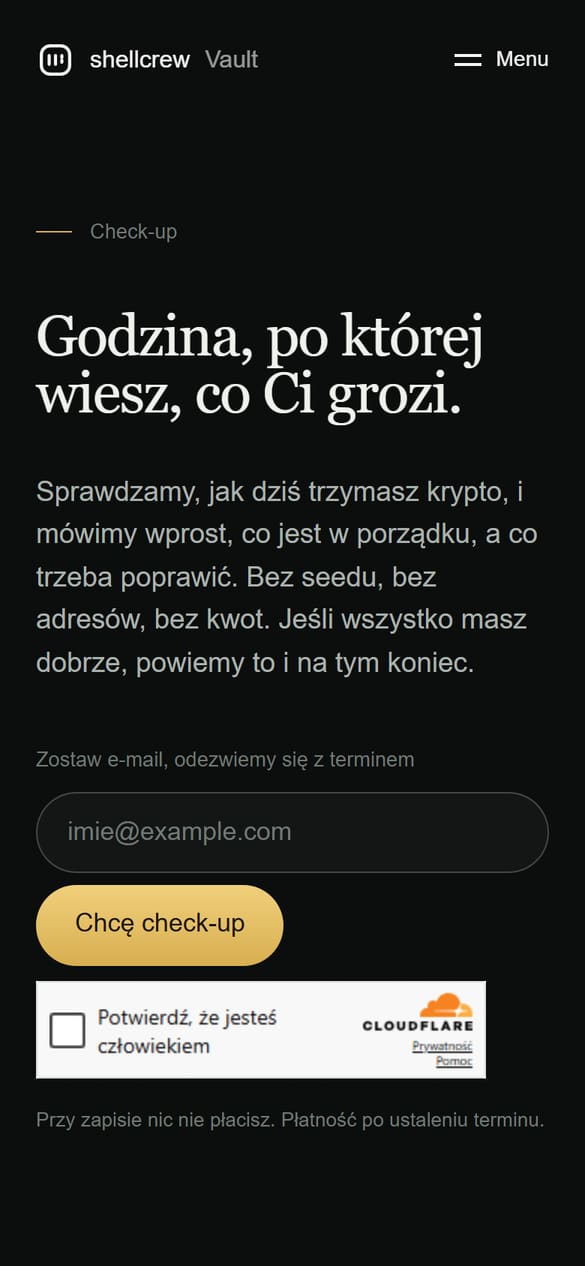
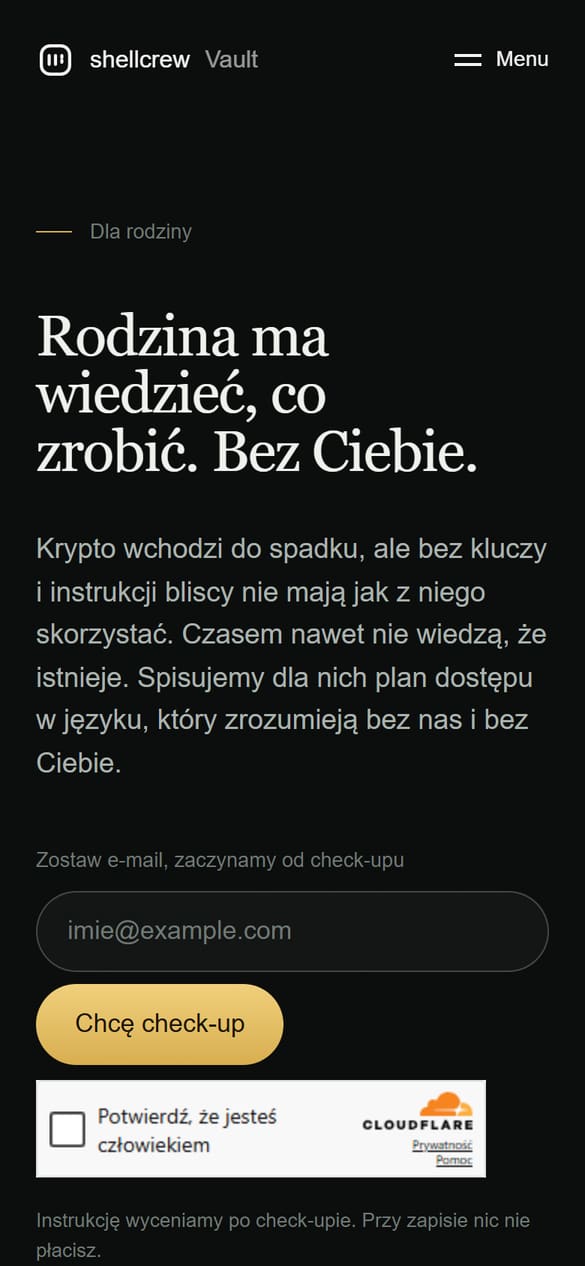
- 06 Service subpages /check-up/ and /dla-rodziny/ with a price, FAQ, and Service structured data
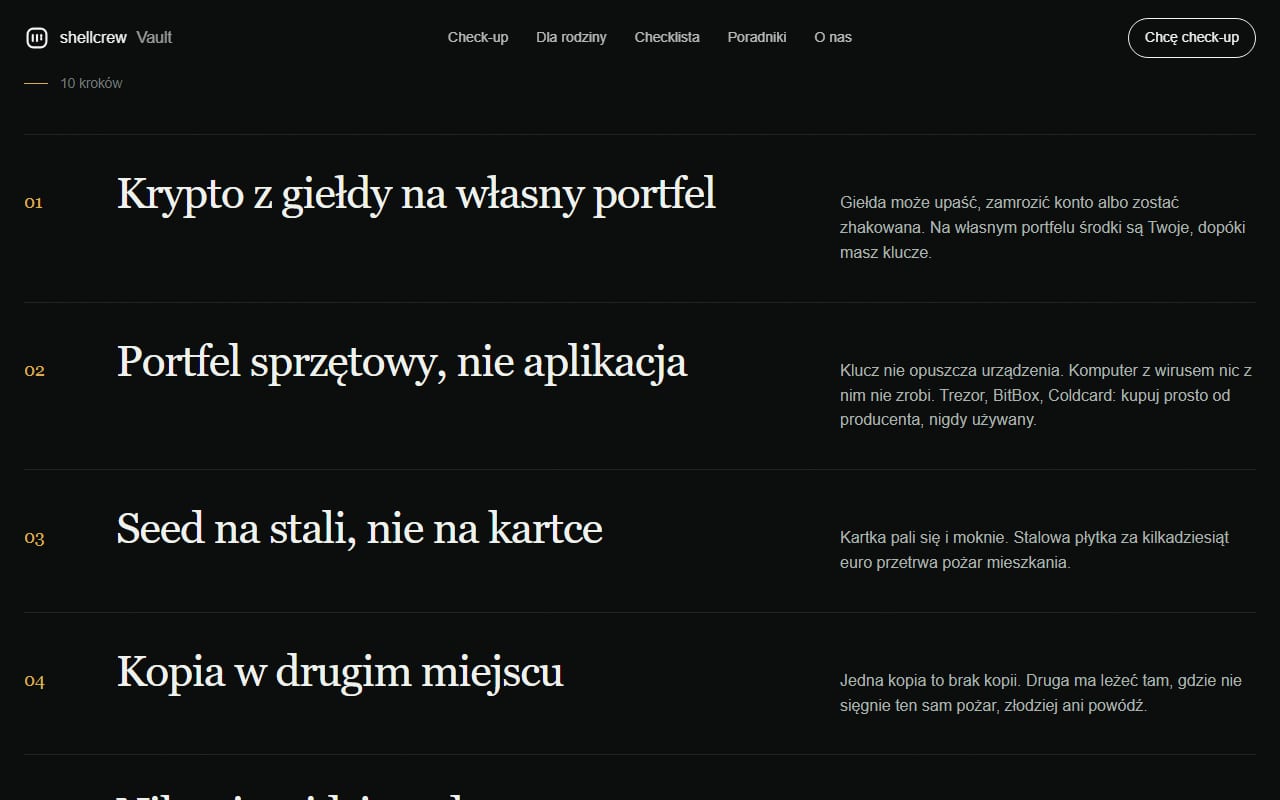
- 07 A 10-step checklist on the page, a printable PDF after leaving an email
- 08 The PDF generated from a separate HTML page by headless Chrome, in A4
- 09 Guides as a content collection with an RSS feed
- 10 A separate link preview image for each subpage
- 11 A mobile menu built on the <details> element itself, without JavaScript
- 12 GSAP animations switched off when the system has reduced motion enabled
- 13 Two sign-up buttons (list and check-up) told apart by a source field, with no API changes
- 14 Form data deleted automatically after 90 days by a daily job
Contents +
- Starting point
- Decisions that shaped the project
- Show the mechanism, don’t promise security
- Zero as the main argument
- Dark steel and brass, without crypto kitsch
- Motion that can be switched off
- Prices on the page from day one
- “Family instructions”, not an “inheritance plan”
- Subpages and a guide for an email address
- A form that measures willingness to pay
- What came out of it
- Technically
Starting point
More and more people keep crypto in their own wallet rather than on an exchange. Few know whether they are doing it right. A sheet with 24 words in a drawer burns with the flat, a phone with an app can be stolen, and when the owner dies, the family often doesn’t even know there was any crypto.
Shellcrew Vault is a service for those people. A one-hour online check-up, help choosing a hardware wallet and a steel plate, setting up a 2-of-3 wallet in which a transfer needs two keys out of three, and an access instruction for the family. There is one rule: the client enters the seed themselves, on their own hardware, and the company has none of their keys.
Shellcrew started as a tool for AI agents. That idea lost to heavy competition, so the project changed its product and its target group. What stayed from the old version is the domain, the server, the sign-up API, and the admin panel. Everything the visitor sees was made from scratch.
Decisions that shaped the project
Show the mechanism, don’t promise security
The words “secure” and “trust us” on a crypto site are read as a warning sign. So in the middle of the page stands the 2-of-3 wallet demo: three key cards (home, safe deposit box, trusted person) and a “I lost this key” button on each. Lose one and the wallet still works. Lose a second and the wallet locks, and the page explains why the keys lie in three different places. A minute of clicking says more than a paragraph about multisig.
Zero as the main argument
The service needs no licence and doesn’t frighten, precisely because the company doesn’t hold the client’s keys. That one fact got a section of its own: a big brass digit “0” and the sentence “That’s how many of your keys we have. Not even one of the three”. Beneath it is a comparison with a driving instructor: they sit beside you, but you hold the wheel.
Dark steel and brass, without crypto kitsch
Crypto sites usually have neon, charts, and rockets. A client over fifty who is thinking about an inheritance needs something closer to a notary than to an exchange. The palette is dark steel with a single brass-coloured accent, grain over the whole page, headings in the serif Newsreader, and text in IBM Plex Sans. On the first screen stands a 3D steel seed plate, an object the client will buy anyway.
Motion that can be switched off
Headings are revealed line by line, the plate tilts after the cursor, and sections slide in on scroll. It all runs on GSAP and switches off when the system has reduced motion enabled. The content doesn’t depend on the animation: without it, the page is simply static.
Prices on the page from day one
The pricing has a switch between four packages: a check-up from €50, setup, family instructions, and care on subscription. The prices are indicative, and the page says so. Hiding amounts on a service for a distrustful client only adds to their reasons for distrust.
“Family instructions”, not an “inheritance plan”
An inheritance plan is legal help, and the company doesn’t provide that. So the service is called an access instruction for the family: who holds which key and what to do, step by step. The legal part is done by a notary or a legal adviser under a separate agreement.
Subpages and a guide for an email address
After the homepage came subpages that links from content and from partners lead to.
The check-up and the family instructions have their own pages with a price, the course of the work, an FAQ, and Service structured data. The prices aren’t retyped by hand: both subpages take them from the same package in the pricing as the homepage, so changing an amount in one place changes it everywhere.
The “Secure your crypto in 10 steps” checklist lies on the page in full, with no gate. After leaving an email in the form, a link to a printable PDF appears. The PDF is made from a separate HTML page in A4, printed by Chrome with no interface. Changing the checklist’s content means editing a text and running one command, without opening a graphics program.
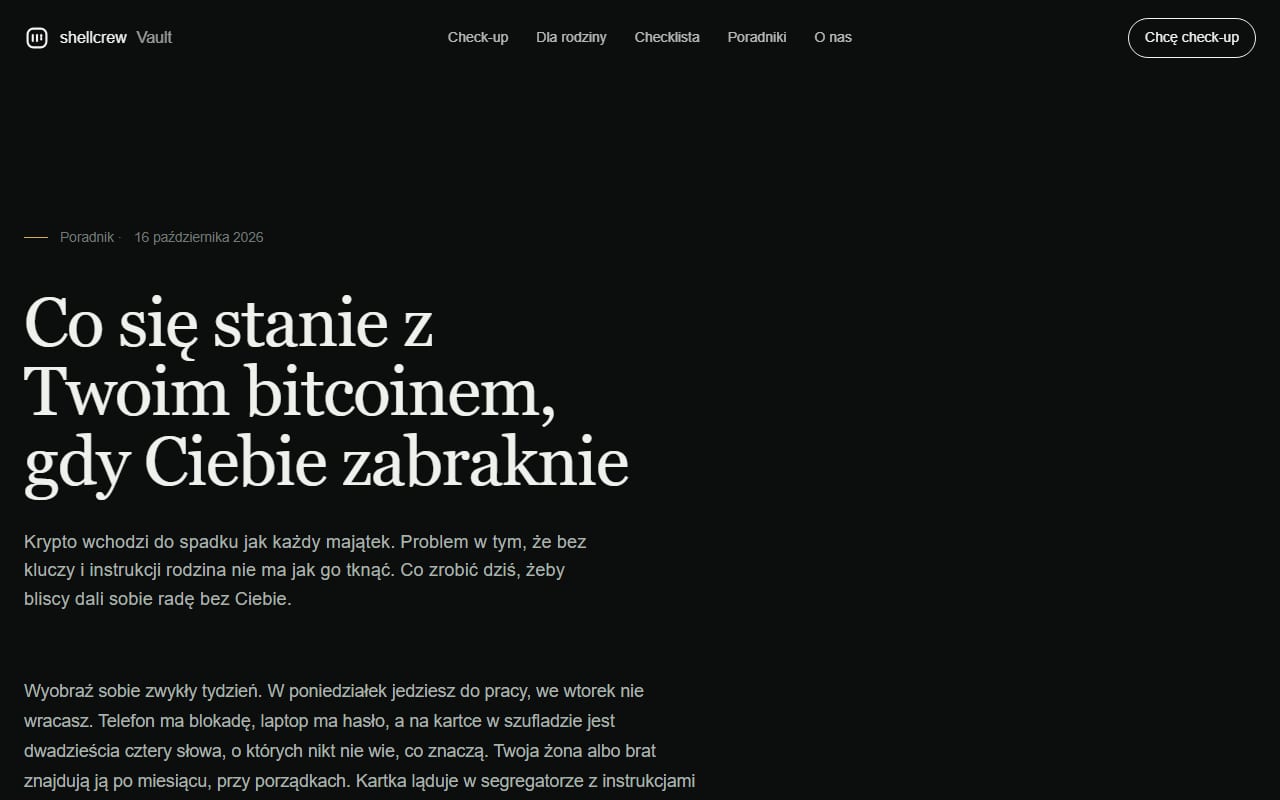
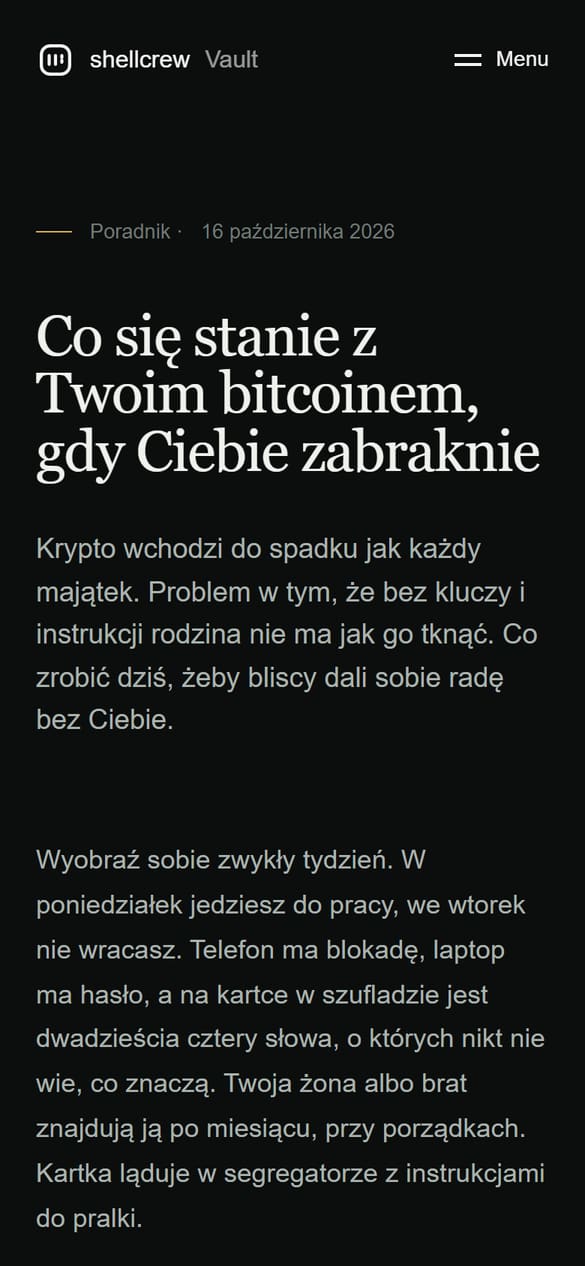
The guides are a content collection with an RSS feed. The first post answers the question clients ask most often: what happens to my bitcoin when I’m gone.
On top of that there is an “About us” page with the founders, a privacy policy, a custom 404 page, and a separate link preview image for each subpage.
A form that measures willingness to pay
The service is in a test phase: for eight weeks we check whether people will pay for it, and only then do we build a brand. The page has two sign-up buttons: “leave your email” and “I want a check-up”. Both go to the same API but with a different source field, and the admin panel counts them separately. The second number says how many visitors are ready to pay, and it needed no change in the backend.
Client security here is also physical security: a list of clients is a list of people with crypto. So the form collects only an email, with no wallet addresses and no amounts. A daily job deletes sign-up data after 90 days, so the promise in the privacy policy doesn’t depend on someone remembering to clean up.
What came out of it
The homepage makes six requests to our own server: the document, two stylesheets, the animation script, the stats script, and its request. 68 kB in total after compression. The first content appears after 0.2 s. The heaviest elements come from outside: the fonts from Google Fonts and the Turnstile widget that protects the form from bots.
The new version was built in a week, because it didn’t start from zero where it didn’t have to. The sign-up API, the admin panel, Turnstile, the statistics, and the deployment went through the change of product without fixes. All the work went into what the client sees.
Technically
Astro with GSAP, all the texts in one file, src/data/content.ts, including the prices that the subpages use. The mobile menu runs on the <details> element, so it opens without JavaScript. The backend is FastAPI in a container with a SQLite database outside the code directory. Caddy serves the static files with security headers and forwards /api/* to the container. Deployment goes from GitHub Actions to a separate account with no sudo, with its own key.
If you need a company website for a service where the client has to trust you before they pay, or a web app with its own backend, it is the same set of decisions.
Screenshots
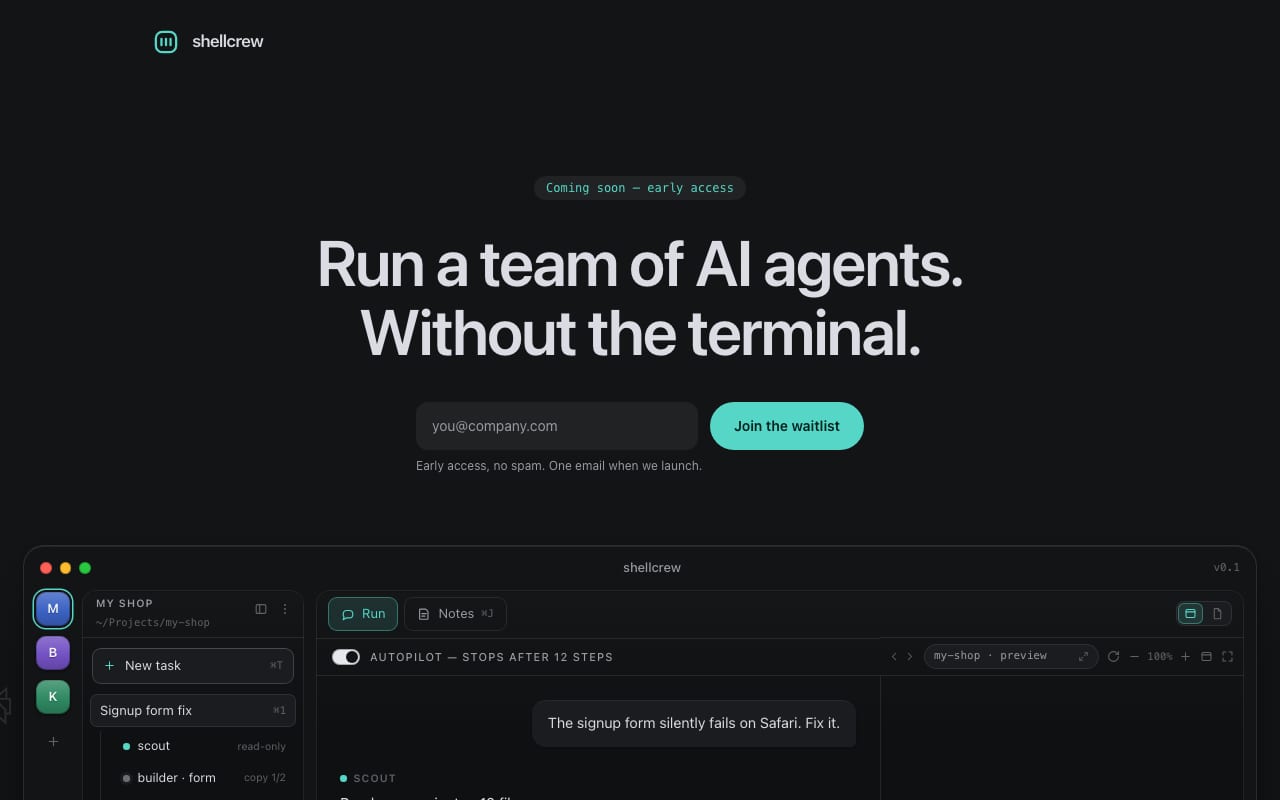
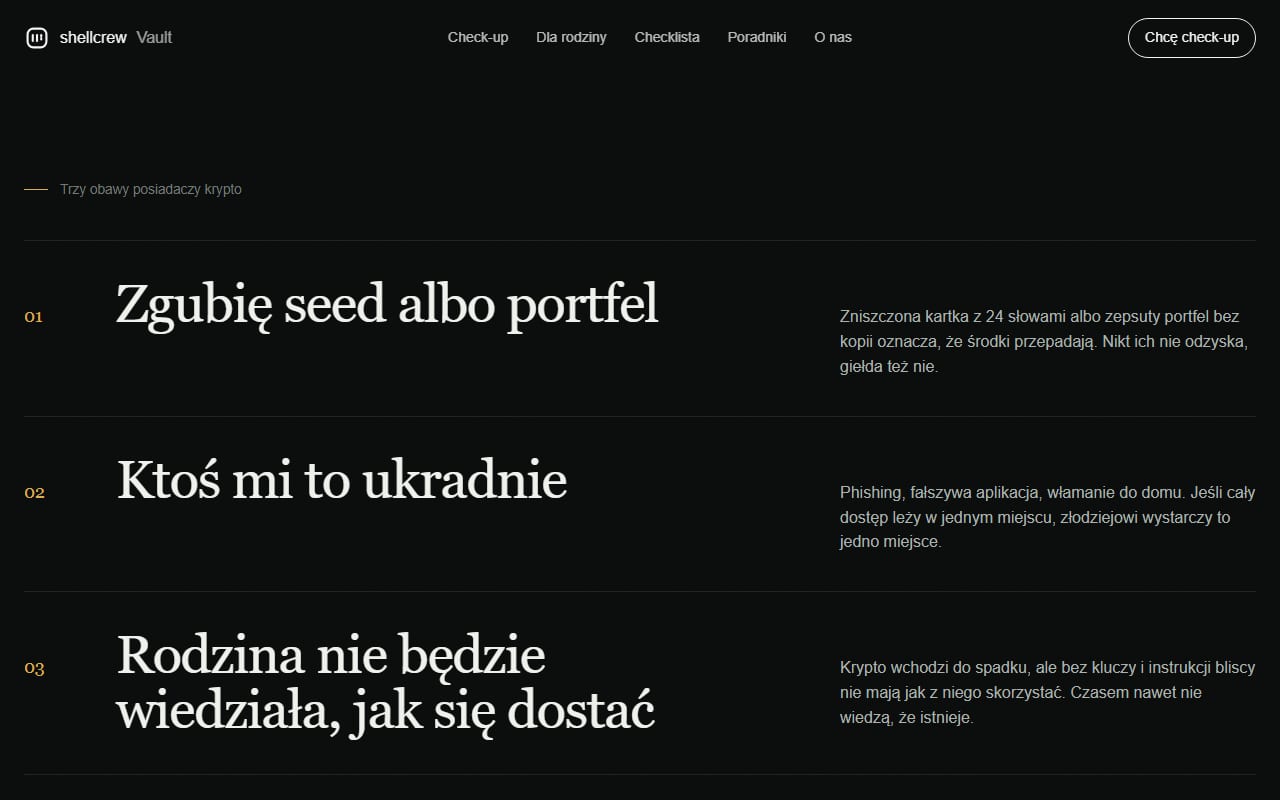
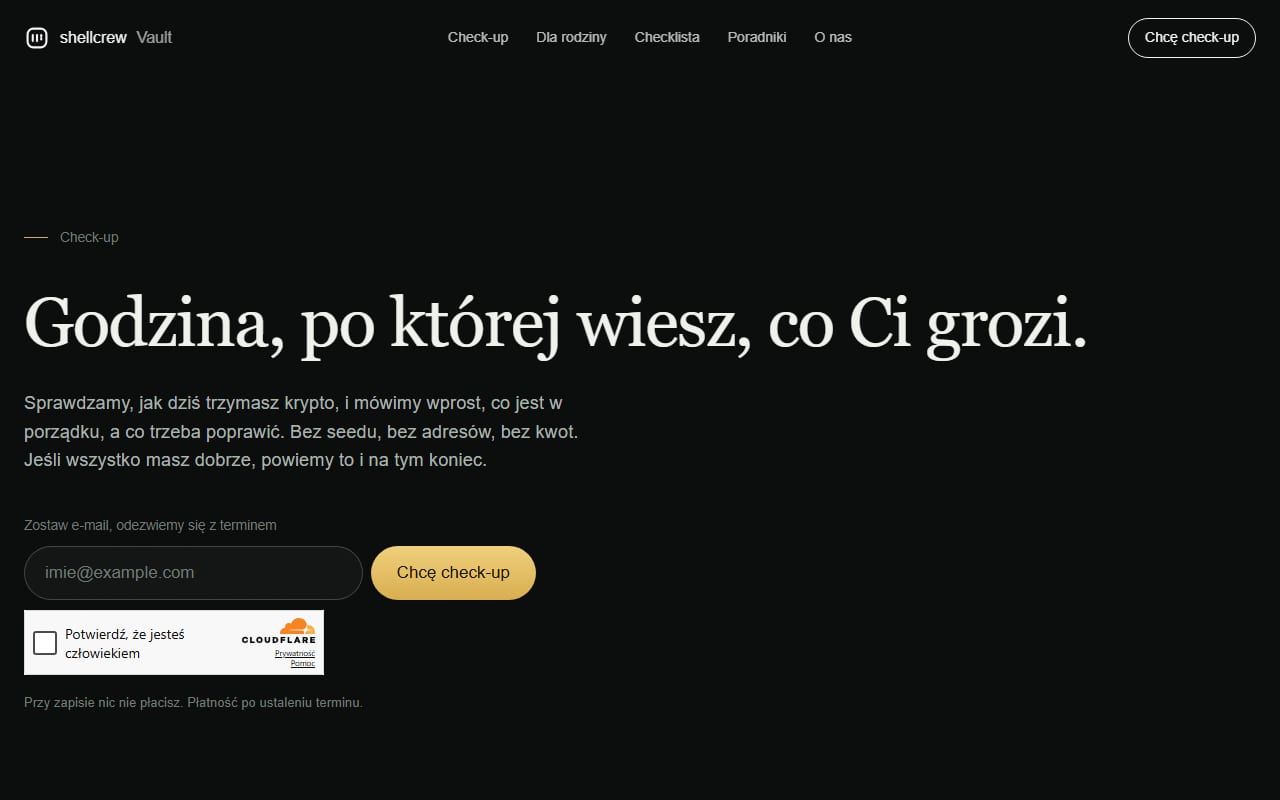
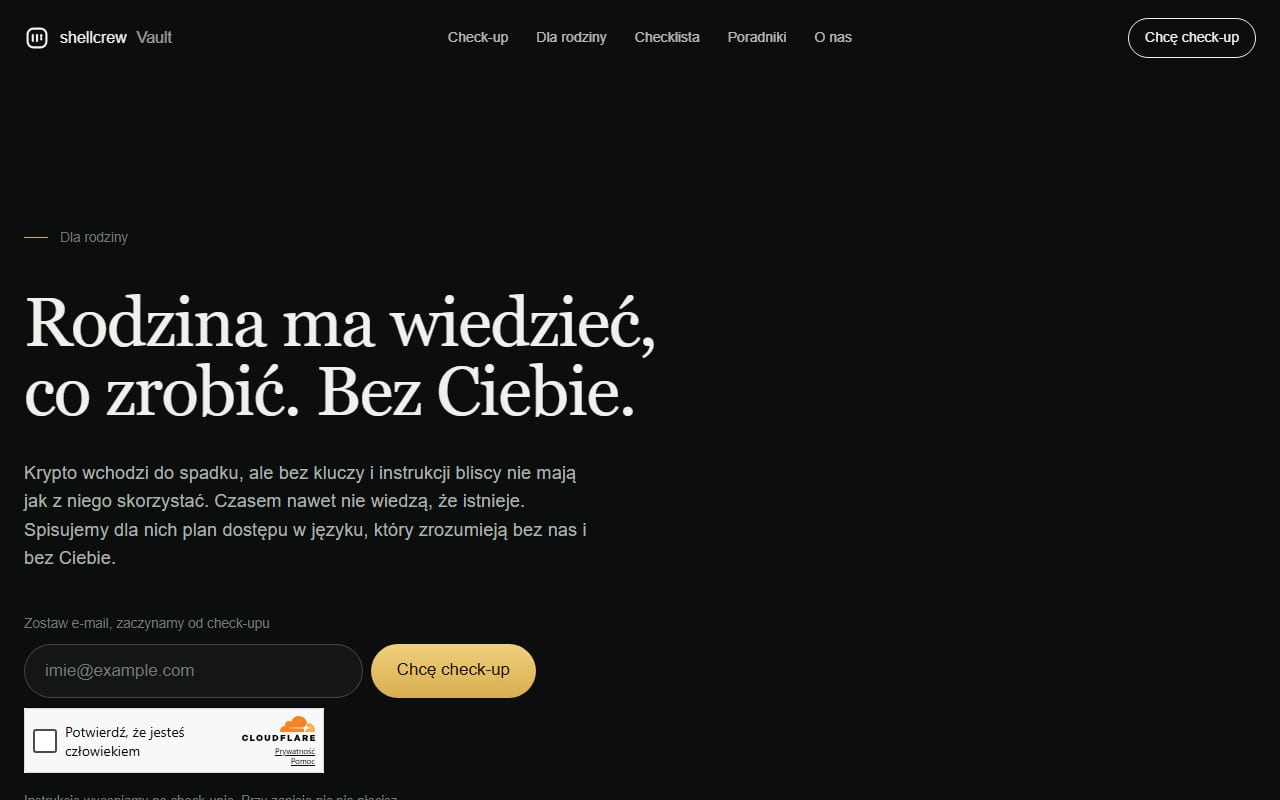
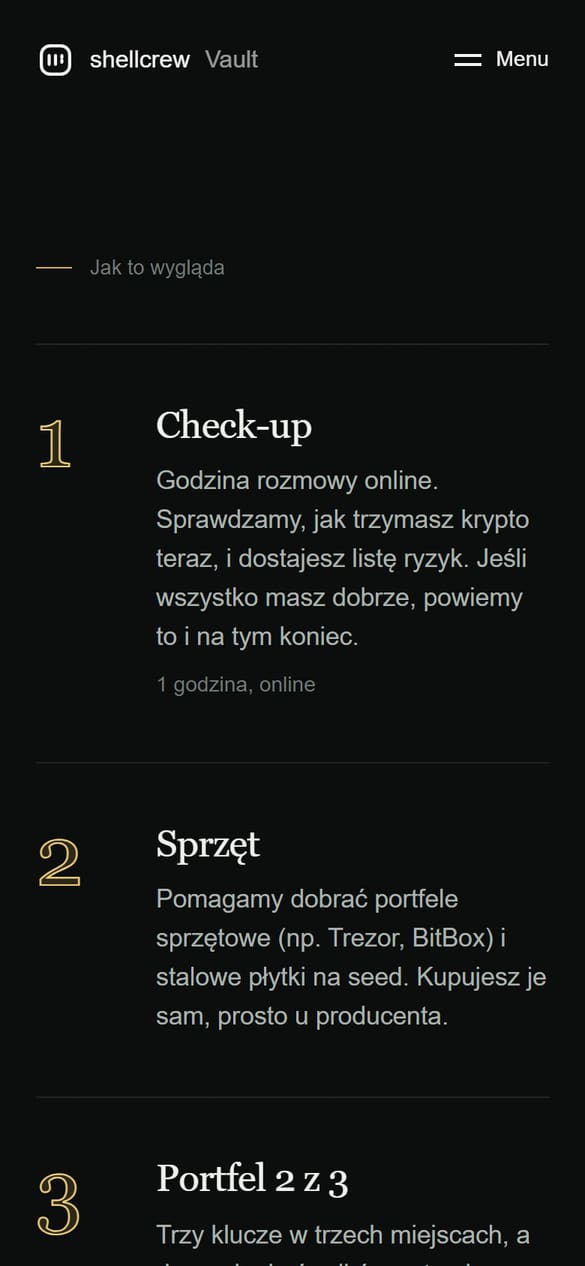
The first screen asks plainly: who will recover your crypto when you are gone? Next to it, a steel plate for 24 words that reacts to the cursor.
A similar problem to solve?
Tell us briefly what it is about. We will send a quote within 24 hours.
Ask for a quote →